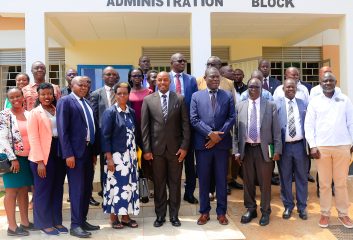

The Minister for Science, Technology and Innovation – Office of the President, Hon. Eng. Jonard Asiimwe Akiiki, led a strategic engagement with Lira University aimed at strengthening the institution’s role in research commercialisation, enterprise development and Uganda’s socio-economic transformation.
Accompanied by the STI Secretariat team, the Minister toured the university’s facilities, assessed its research infrastructure and innovation capabilities, interacted with young innovators and held a high-level strategic meeting with university leadership. With more than 600 acres of land and a substantial student population, Lira University presents significant opportunities for advancing innovation, industrial development and economic growth in the Lango sub-region and beyond.
During the discussions, the Minister emphasised the need for universities to prepare for students transitioning from the competency-based curriculum, who are being equipped with critical thinking, creativity and practical problem-solving skills. Drawing on Darwin’s theory of natural selection, he challenged universities to adapt their teaching methods, research approaches and institutional structures to remain relevant in a rapidly changing educational and technological environment.
At an innovation exhibition featuring projects from university students and neighbouring secondary schools, including Mentor Secondary School, the Minister observed the emerging potential of young innovators willing to experiment and pursue ideas without fear of failure. Impressed by a young female student who confidently explained a medical innovation, he offered her a scholarship and assigned her to an STI expert for mentorship and further guidance.
During the exhibition, Doreen Gift Bujingo from the STI Secretariat’s Industry 4.0+ Bureau introduced the Pearl of Africa Innovation Series (PAIS), an initiative expected to reach the Lango sub-region to identify and nurture promising innovations from both formal and informal settings. The initiative seeks to connect grassroots innovators with researchers, technical experts and institutions to support innovation development and commercialisation.
The Minister challenged universities to translate knowledge and skills into productive enterprises, asking, “If prisoners can generate income for a prison, why can’t students generate income for their university?” Reflecting on changing global economic and technological developments, he further asked, “Who are we to remain comfortable at such a defining moment in world history?” emphasising the urgency of transforming university education, research and innovation.
The discussions also examined intellectual property (IP) ownership, royalty-sharing arrangements and research commercialisation frameworks within universities. Concerns were raised that existing IP and royalty-sharing mechanisms are creating recurring conflicts among universities, researchers, students and other stakeholders, potentially undermining collaboration and slowing the commercialisation of innovations. The engagement highlighted the need to review and strengthen these frameworks to establish clear ownership rights, equitable royalty-sharing arrangements and transparent commercialisation pathways that protect the interests of all parties while encouraging innovation and enterprise development.
During the strategic meeting, the Minister committed to expediting Lira University’s proposals for an improved ICT facility through engagement with relevant ministries. The STI Secretariat will also explore international partnerships with leading institutions worldwide, alongside opportunities to upgrade basic laboratories into modern, well-equipped research and simulation facilities.
At the Regional Presidential Skilling Hub hosted at Lira University, the Minister interacted with young people acquiring practical skills in carpentry and joinery, masonry, tailoring and cosmetology. He offered start-up capital to two students pursuing carpentry and joinery and cosmetology, respectively, with Ministry teams expected to follow up on how they apply their skills to generate income and support their communities.
The engagement reaffirmed the Ministry’s commitment to strengthening university–industry collaboration, research commercialisation and the transformation of academic knowledge into practical solutions, competitive enterprises and employment opportunities, in line with Uganda’s Ten-Fold Growth Strategy and the national ambition of building a US$500 billion economy by 2040.
#STIUganda #STIWorks