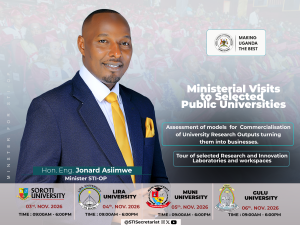

Soroti City, Uganda
Hon. Eng. Jonard Asiimwe Akiiki, Minister for Science, Technology and Innovation – Office of the President, has called upon Soroti University to strengthen its focus on practical research, innovation and commercialisation as part of efforts to position universities as engines of Uganda’s economic transformation.
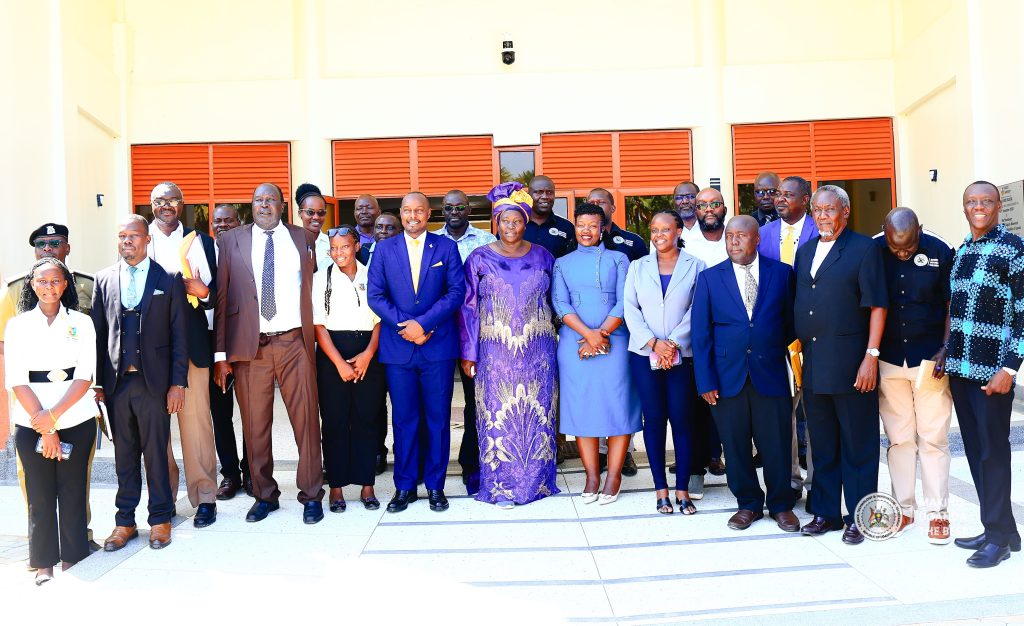
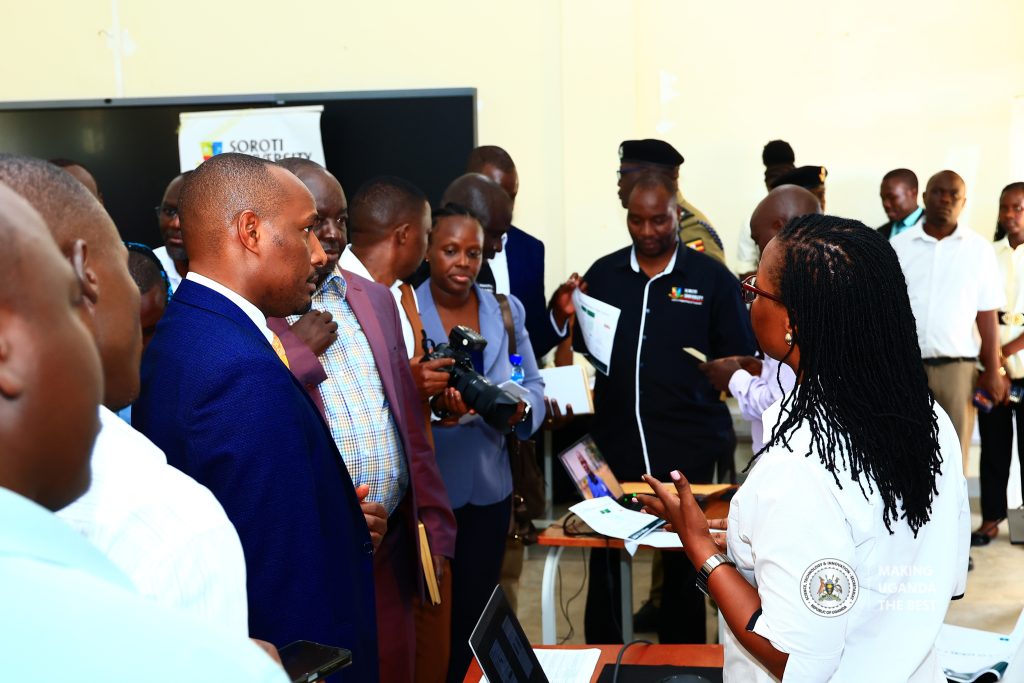
The Minister made the remarks during an official visit to Soroti University, accompanied by a delegation from the STI Secretariat, where he assessed the institution’s research infrastructure, laboratories, innovation projects and opportunities for industrial collaboration.
From Teaching Laboratories to Innovation Centres
Following a tour of the university’s facilities, the Minister acknowledged the institution’s strong foundation but observed that several laboratories remained largely focused on basic teaching activities, including titration and other routine scientific experiments.
He emphasised the need to progressively transform such facilities into advanced innovation laboratories capable of supporting applied research, product development, idea simulations and commercialisation.
“The true measure of a university’s contribution to transformation is not only the number of graduates it produces, but also the problems solved, jobs created and lives saved,” the Minister emphasised.
To advance this transformation, Hon. Eng. Jonard directed a technical team led by Dr. Cosmos to undertake a comprehensive assessment of the university’s laboratory requirements and identify opportunities for upgrading existing facilities into innovation-oriented research infrastructure.
Linking University Research to Local Industries
The Minister further challenged Soroti University to establish stronger partnerships with industries operating within Soroti City and the surrounding region, ensuring that research responds directly to market needs.
Citing small-scale maize-milling enterprises as an example, he encouraged the university to assess industrial production challenges, including electricity consumption, production efficiency and operational costs.
He explained that evaluating energy consumption against the quantity of maize processed would enable researchers to develop practical technologies that improve productivity and reduce operating expenses.
Such an approach, he noted, would create opportunities for local enterprises to become customers for university-developed innovations, strengthening the relationship between academia and industry.
Advancing Nuclear Science, Manufacturing and Bioeconomy Research
During the engagement, the Minister also considered proposals aimed at expanding the university’s scientific and technological capabilities.
Among the proposals discussed were the establishment of a Centre for Nuclear Science and Technology, the development of a pilot manufacturing facility modelled on the Engineering Development and Innovation Centre (EDiC), and enhanced support for the university’s Institute of Bioeconomy.
He highlighted the importance of further technical engagements to assess the feasibility, infrastructure requirements and potential economic contributions of the proposed initiatives.
These interventions are expected to strengthen the university’s capacity to undertake applied research, develop commercially viable technologies and contribute to Uganda’s industrialisation agenda.
Strengthening International University Partnerships
As part of efforts to expand Soroti University’s research capabilities, the Minister announced plans for the STI Secretariat to facilitate strategic connections between the university and international academic institutions.
He indicated that the Ministry would support these engagements by covering flight costs and related expenses, enabling university representatives to explore opportunities for scientific collaboration, technology transfer, research partnerships and institutional capacity development.
The initiative seeks to expose the university to international expertise while strengthening its ability to translate scientific knowledge into practical solutions for Uganda’s development priorities.
Five-Year Commitment to Measurable Transformation
Hon. Eng. Jonard pledged continued engagement with Soroti University over the next five years, stressing that institutional partnerships and policy discussions must produce tangible and measurable results.
He reiterated that universities should increasingly be assessed not only by academic output but also by their contribution to enterprise development, industrial productivity, employment creation and improved livelihoods.
The engagement forms part of the Ministry for Science, Technology and Innovation – Office of the President’s broader efforts to accelerate research commercialisation, import substitution, export promotion and industrial development in line with Uganda’s Ten-Fold Growth Strategy anchored on ATMS.
Through stronger collaboration between universities, industries and Government, the Ministry seeks to ensure that scientific research contributes directly to Uganda’s ambition of building a US$500 billion economy by 2040.
#STIUganda #STIWorks